
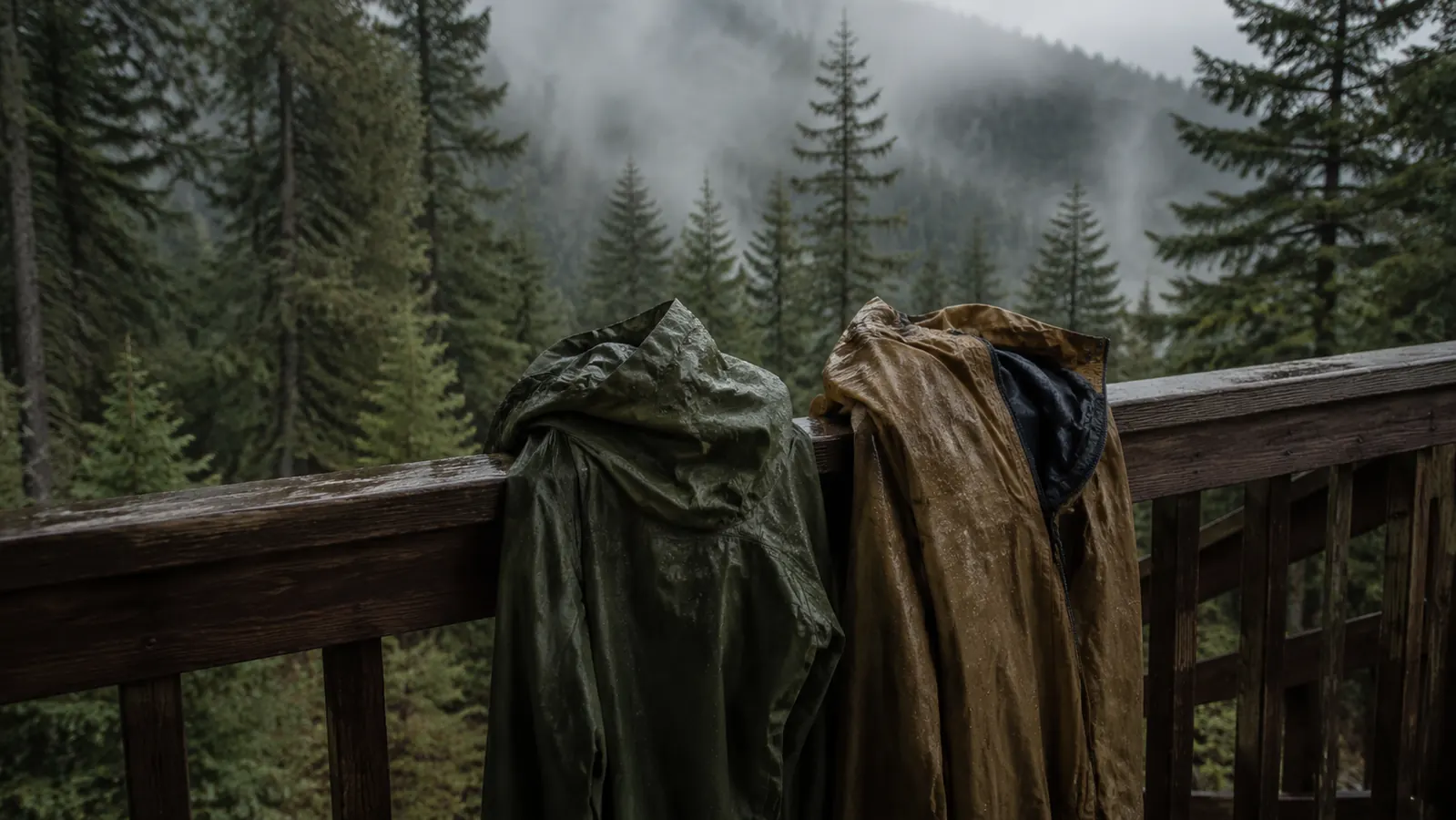
Two jackets sit on the same wet porch rail in front of me, and if you have looked up cheap rain gear for the Pacific Northwest at all, you have already seen both names. On one side is the Marmot Precip Eco, the hardshell that has been a quiet staple of rainy-climate hiking for years. On the other is the Columbia Watertight II, the ultralight that shows up in every roundup of budget shells and packs down into nothing. Both are sold as answers to the same question: which no-frills rain jacket keeps a person dry when the weather refuses to cooperate for days at a time? After a whole soggy spring with both of them, I can tell you they are not interchangeable, and the difference is not on the spec sheet.
Here is the short answer before I bore you with the details. The Marmot Precip Eco is the one still hanging in my hall closet, dry and ready for the next downpour. The Columbia Watertight II got demoted to the trunk of my truck, where it now lives as a what-if layer I grab for the odd passing shower and nothing more serious. That split happened over months of real use, not a careful hour of testing in a parking lot, and it came down to one thing I did not fully appreciate until I had worn both uphill in the rain: a jacket that keeps the outside dry but turns the inside into a sauna has only done half its job.
Let me be clear about how I tested them, because it matters. I am a Pacific Northwest generalist, the kind of person who hikes the Cascades, camps in the rain, and fishes the coast, not someone with a lab or a torture-test budget. From March through June I rotated the two jackets on rainy day hikes, on coastal walks where the Olympic drizzle just hangs in the air and never quite commits, on pack-heavy trips, and through one genuinely ugly three-day stretch where it rained without a real pause. Same merino base layer underneath each time, same routes, same effort on the climbs. I was not trying to prove anything. I just wanted to know which one keeps a person dry on the days it actually matters, which one stays comfortable enough to keep wearing, and which one only looks like it would.
| Marmot Precip Eco | Columbia Watertight II | |
|---|---|---|
| Current price | Check Today's Price on Amazon | Usually the cheaper of the two |
| Waterproofing | Seam-taped, holds in all-day rain | Seam-taped, fine in lighter rain |
| Breathability | Better, dries out faster on climbs | Runs sweaty on any real effort |
| Pit zips | Two full-length zips | None |
| Weight | A bit heavier, sturdier fabric | Lighter, packs noticeably smaller |
| Hand pockets | Two zippered hand pockets | One chest pocket, doubles as stuff sack |
| Hood | Adjustable, holds its shape | Adjustable but thin and floppy |
| Best for | All-day PNW rain, year-round hiking | Occasional light rain, packability |
| Overall | Winner for real PNW use | Great value as a spare |
That table is the short version, and honestly it is a decent summary of the trade-offs. But tables flatten the nuance, and the nuance is exactly where these two jackets stop being a close call. To understand why the Marmot and the Columbia wound up in such different corners of my life, you have to understand how much you sweat moving through a wet PNW landscape, and what each jacket does with that heat.
The Precip earns its place in the rain.
The Columbia is a fine jacket to own. But when the choice is which one keeps you dry through the real thing, the Precip's pit zips and sturdier fabric won every single hike this spring.
Amazon Check Today's Price on the Marmot Precip Eco →Where the Marmot Precip Eco Wins
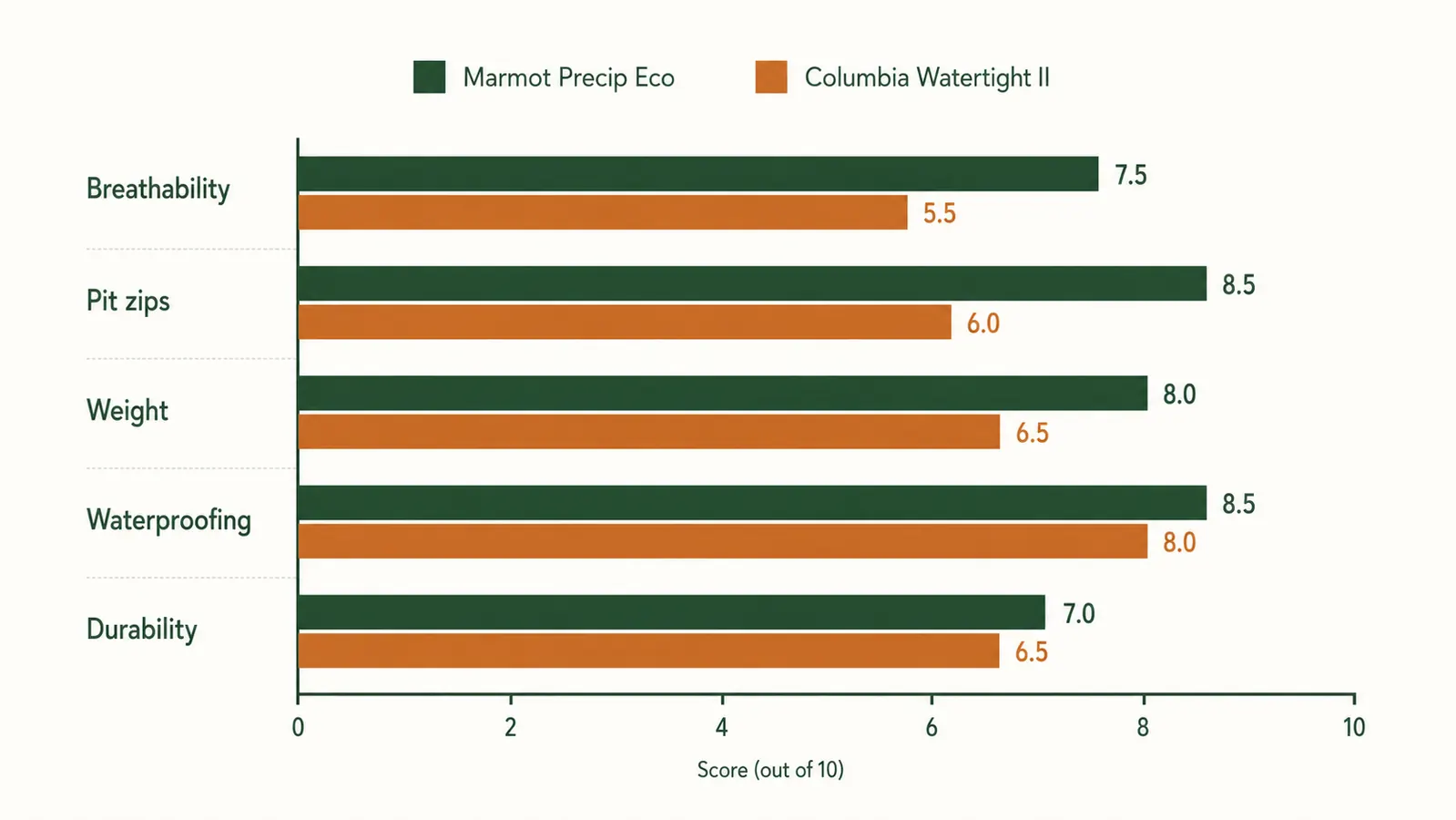
The Precip's biggest win is not what most people assume. It is not the waterproofing, and it is not some fancy membrane. It is the two pit zips that run down the sides, and I am going to spend real time on them because they are the single reason the Marmot won my spring. Here is the thing a spec sheet will not tell you about the Pacific Northwest: it rarely pours on you relentlessly all day. It mists, it drips, it sweats through a fifty-degree cloud, and the trail still climbs. Under any waterproof shell you work up a serious amount of heat, and that heat has to go somewhere. On the Marmot I unzip both pits a few inches on every steep section and the heat escapes right where the body produces the most of it, under the arms. I stay warm without turning the jacket into a steam room.
On the Columbia, wearing the same base layer and pushing at the same effort, I was soaked from the inside out by the top of the first long climb every single time. Not by rain, by my own sweat, which is colder and more miserable than any drizzle once you stop moving. A jacket that keeps the wet out but traps every drop of your own effort is only half a jacket, and for anyone who lives where the hiking involves elevation gain in the rain, that is not a minor quibble. It is the difference between a layer you reach for happily and one you dread. The pit zips on the Marmot are the feature that makes a waterproof shell genuinely wearable instead of a clammy punishment you endure until the car.
The second win is the fabric itself, and this is where the two jackets visibly part ways even before you add effort. The Precip feels like a real shell. It is a little heavier, a little denser, with a matte finish that has absorbed a full season of tree branches, pack straps, and the kind of damp underbrush you only push through when the trail peters out and you decide to bushwhack the last hundred yards. Squeeze the two jackets side by side and the Marmot has substance while the Columbia feels like crinkly paper in comparison. Neither one is a proper alpine mountaineering shell, and I will not pretend otherwise. But after this spring the Marmot still looks like it has several seasons left in it, while the Columbia already shows the kind of wear that makes me inspect it before I trust it in real rain.
Then there is the all-day part of the equation, which is the part that actually decides whether a rain jacket earns its place in my closet. When the rain genuinely does not stop, when you are three miles from the car and it has been wet for four straight hours, the Marmot is the one I trust to stay honest to dry. The seams are taped where they need to be. The DWR finish keeps beading water off the shoulders long after the Columbia has gone dark and shiny with soak-through. The zippered hand pockets keep my fingers warm and my phone dry instead of funneling water into the cuffs like the interior of a cave. It is not a miracle jacket. No budget hardshell is, and I would never tell you otherwise. But it is predictable, and predictability is worth a lot when the weather refuses to give you a single dry hour to plan around.

Where the Columbia Watertight II Wins
To be fair to the Columbia, it is not trying to lose this argument, and there are places where it genuinely beats the Marmot, not just ties it. Weight and packed size are the big one, and I will not undersell them. The Watertight II weighs noticeably less, and with that single chest pocket that doubles as its own stuff sack, it rolls down to almost nothing. It disappears into a corner of a daypack, a glove box, or the bottom of a canoe in a way the Marmot simply cannot match. If your rain jacket is mostly a what-if, a thing that lives in your pack for the odd passing shower and spends ninety percent of its life folded away, the Columbia is the better choice, full stop. It is there the two days a month you need it and completely out of the way the other twenty-eight.
It is also, in most weeks of the year, the cheaper of the two, and I want to be straight about what that means before anyone writes me off as a brand loyalist. If you want a dependable rain layer for occasional use, errands in the city drizzle, a rainy ball game, an emergency shell for the boat, the Columbia does that job for less money, and that is a real, honest reason to buy it. Bargain hunting is not wrong, and not every rain jacket needs to be a mountain shell. Plenty of people live in places where a light, packable, affordable shell is exactly the right call, and for them the Columbia is the right pick. The mistake is reaching for it as your primary year-round Pacific Northwest hiking jacket, because that is the one job where its thin fabric and missing pit zips let you down on the exact days you need a jacket the most.
There is also something to be said for the lightness if you are a gram-counter on a long trip where every ounce in the pack earns its keep. On a multi-day backpack where rain is a possibility rather than a certainty, the ability to carry a dependable waterproof layer that weighs almost nothing is a real advantage, and the fact that it doubles as its own stuff sack means you never lose the bag. I am not going to pretend there is no room for that. The Columbia is a genuinely useful piece of kit. It just happens to solve a different problem than the one a year-round PNW hiker faces, and once I understood that, a lot of the confusion about which jacket was better evaporated. They are both good. They are good at different tasks.
The All-Day Test That Settled It
The moment that pushed me firmly toward the Marmot happened on the kind of weekend that makes you question your choice of hobby. Three consecutive days of steady rain, the Cascades doing exactly what the Cascades do, on a trip where getting off trail was not an option because the car was a full day away. Day one I wore the Columbia and by the second hour the inside of my shoulders was damp with my own sweat, which is a worse cold than any rain because it does not stop when the weather lets up. By the afternoon I had the collar pulled up and the thin hood cinched so tight around my face that I felt like I was carrying the whole storm on my head, and I still could not get comfortable.
Days two and three I wore the Marmot, and the difference was not dramatic, it was just steady and reliable. The pit zips let the heat out on the climbs. The sturdier hood held its shape instead of collapsing into my eyes. The denser fabric shrugged off the endless dripping instead of going dark and clammy. Nobody is going to call three days in the rain an enjoyable experience, rain gear cannot fix the weather, it can only refuse to make it worse. But at the end of that trip the difference in how I felt, dry-ish and warm versus chilled and fogged in, was the difference between a jacket that works with my body and one that works against it. That weekend is why the Marmot Precip Eco has a permanent hook in my hall closet and the Columbia has a permanent spot in the trunk.
Who Should Buy Which
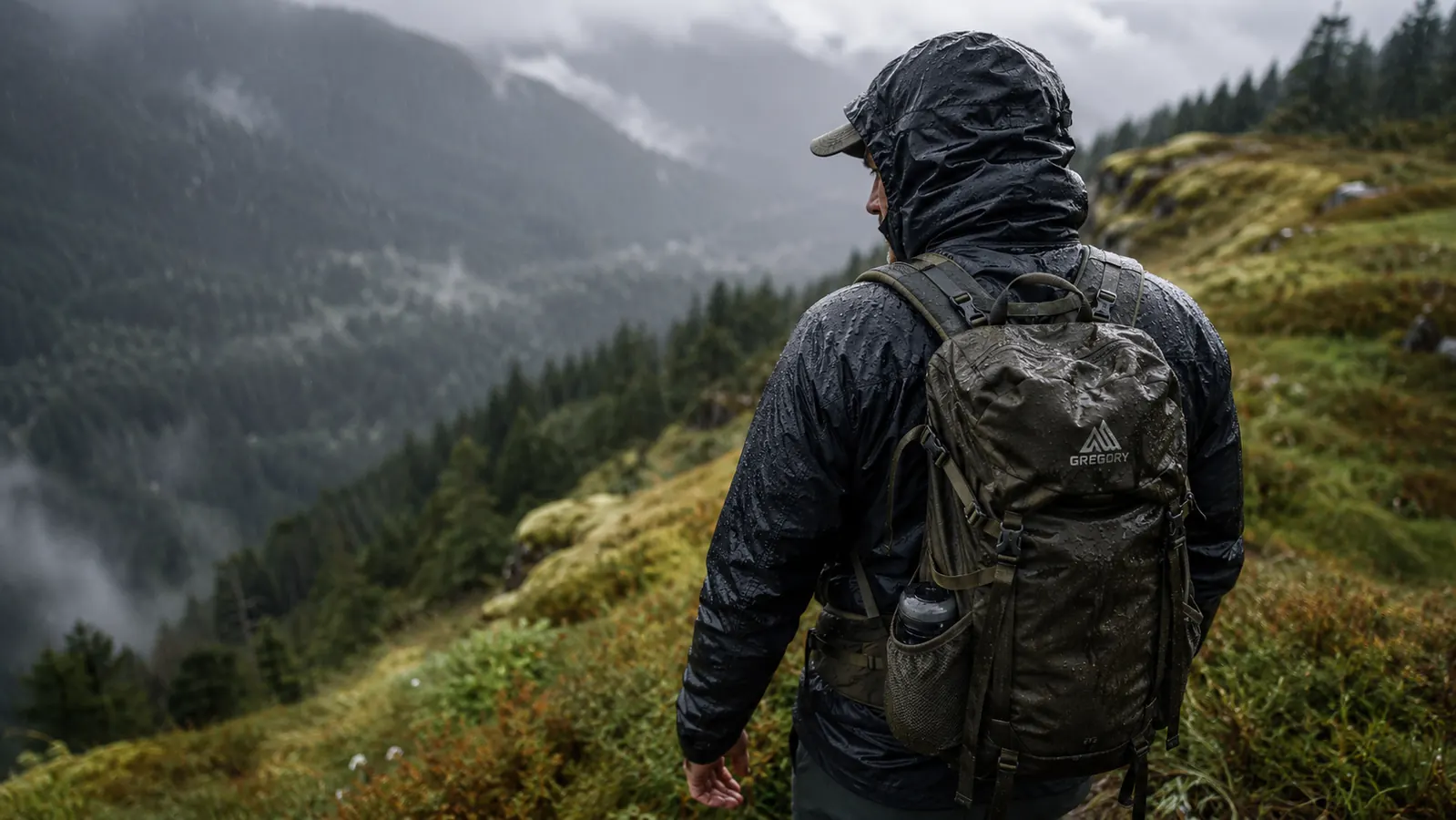
Buy the Marmot Precip Eco if you actually hike the Cascades, the coast, or the rain shadow through the winter and spring, and you want one jacket that reliably does the full job for years rather than one season. Buy it if you sweat on the uphills, because the pit zips are the single feature that makes a waterproof shell wearable instead of a punishment. Buy it if you are tired of rain gear that quits on you mid-season, and you want zippered hand pockets, a hood that holds its shape, and a shell that still looks respectable after a brush with real underbrush. It is the grown-up pick for a climate that rains more than it does not, and it is the one I reach for whenever a weather report says rain until Friday.
Buy the Columbia Watertight II if you are weight obsessed on a trip where every ounce counts, if your rain jacket is a just-in-case layer rather than a daily driver, or if you want the most affordable dependable single-layer shell that still gets its seams taped and still keeps a passing shower off you. It has a genuinely useful place in the gear drawer, and I am not here to talk anyone out of owning one. It saves weight, it packs small, and it costs less, all of which are honest virtues. Just understand that its job is the occasional downpour handled lightly, not the all-day soak where you are moving through the hills. Reach for it as a spare and you will be happy with it. Ask it to do the Marmot's job and you will end up soggy from the inside.
For what it is worth, I think most people who live where it rains for months at a time already know which of these they need, and the comparison mostly just confirms it. If the phrase all-day PNW rain makes you reach for your boots and a pack, the Marmot Precip Eco is the jacket for you. If the phrase makes you think about a light thing you can forget until you need it, the Columbia is probably fine. There is no wrong answer here, just the right tool for the right job. I know which one I will keep packing for the rest of the year, and it is the one that dried out faster, breathed through its pit zips, and held up to a full season of real use.
Buy the jacket that buys back your weekends.
If you live and hike where it rains for months at a time, the Precip Eco is the one to reach for every time. The Columbia still has a job, just a smaller one. I know which one I will keep packing.
Amazon See Today's Price on the Marmot Precip Eco →