
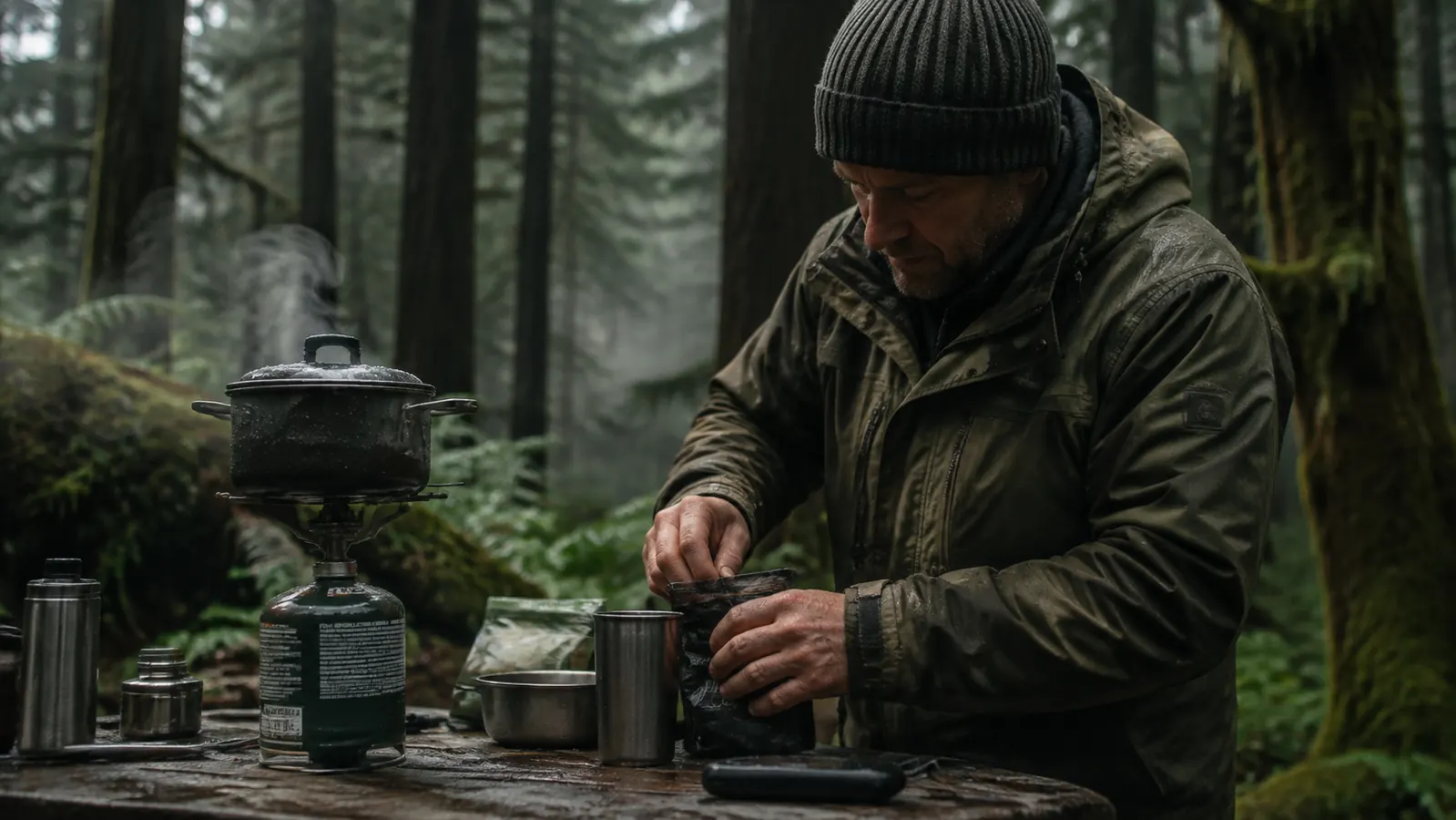
Here is the review I went looking for and could not find. Every write-up on the Coleman BottleTop opens with how dependable it is, how it fires up in the rain, how it has been the camp stalwart for years, and all of that is true, I have owned one for most of a Pacific Northwest winter now and it did not let me down once. But nobody who typed those words seems to have cooked a windy dinner on a half-empty canister in the cold with a tall pot wobbling on top and a burner that will not sit still for a gentle sim. I bought the glowing reviews, hit my first real evening, and spent ten minutes learning five things no review bothered to tell me. This is the version I wish had existed first, so you can decide with both hands open instead of one.
I am a Pacific Northwest generalist, not a chef and not a sponsored reviewer. My stove cooks breakfast in the Cascades, gets hauled down to the coast for salmon season, and does dinner under a tarp when the rain will not quit. I do not baby it, and I do not write a review after boiling water one time in good conditions on a sunny deck. I wanted a dependable single burner for a fair price, and the BottleTop mostly is exactly that. But the honest version has ragged edges, and pretending they are not there is how people buy the thing, get a windy week, and quietly swear at a burner under their breath. Let me tell you where the ragged edges actually are.
The Quick Verdict
A genuinely dependable single-burner that honestly earns most of its reputation, sold on a reputation that hides three real irritations: it is top-heavy in the wind, the valve is range-y but not precise, and it gets weak-tempered late in a cold canister. Good value, not the magic the marketing implies.
Amazon Check Today's Price →Dependable, yes. Perfect, no. Here is what the glowing reviews skip.
I tell you exactly what annoys me about the Coleman BottleTop, then I tell you why I still keep it. Check today's price on Amazon and decide with the honest picture.
Amazon Check Today's Price on Amazon →How I've Used It
My BottleTop has cooked on wet picnic tables in the olympic rain shadow, on the tailgate of a truck by a foggy river mouth, and on the gravel outside a tent in a place where the wind came off the water sideways. The cookbook in my head is the honest kind: a pan of fried eggs that went fine, a pot of chili that scorched the bottom when I trusted the valve's low setting a little too far, a morning where the coffee finally came up just as I was about to give up. One warm season ago I would have called this the best stove I had ever owned. Now I know its moods, and knowing them has not made me love it less, it has just made me plan around them.
What I have not done is leave it in a pristine gear locker. It rides in the truck bed crammed between a bag of firewood and a tackle box. It has been rained on, dropped once onto gravel, and left out overnight more than once when I was too tired to put it away. That is the real test, and to its credit the BottleTop has passed the abuse part cleanly, nothing has come loose, no grate has bent, no valve has seized. The durable stuff holds up, exactly as everyone claims. The annoying stuff is what nobody tabulates, and that is what this review is actually about.
Cooking in the Rain Is Its Own Sport
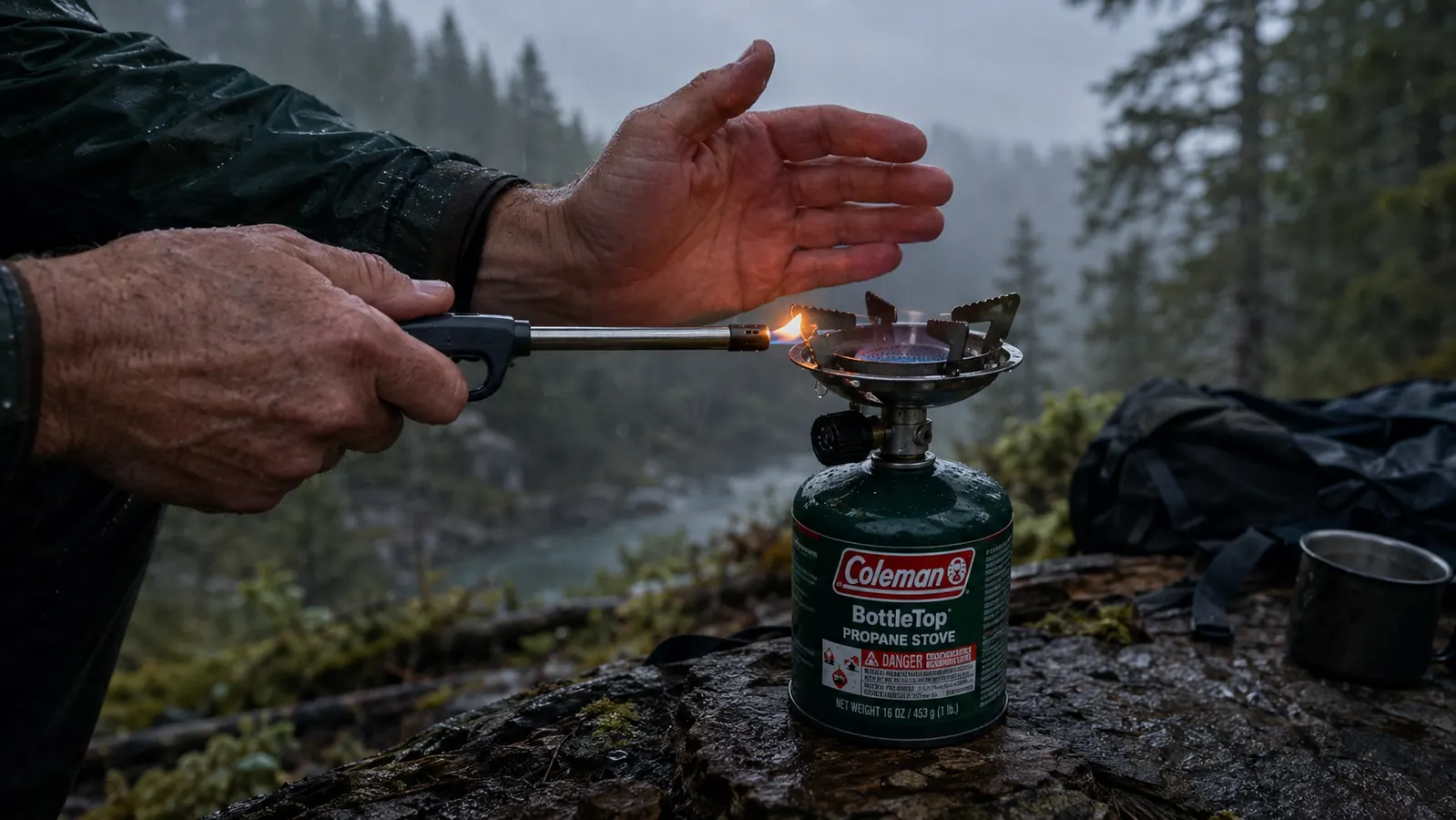
Out here we measure camp gear in soaked-finger mornings, and the Coleman BottleTop has been through more of those than the marketing photos ever promise. When the rain comes in sideways and everything you touch is damp, what matters is a burner you can start without a prayer and a stove that sits low enough to shelter under the lid of your pot. I have cooked a full breakfast, eggs and potatoes and a pan of bacon, in a steady drizzle with the BottleTop parked on a camp table beneath a half-open tarp, and the only complaint was my own patience, not the stove. Steam rises, the rain beads on the flat metal, and the flame just sits there doing its job. That is the part the reviews mean when they call it dependable, and it is real.
The tailgate test is the one I trust most. Come winter, on a foggy river-mouth morning with the truck pointed at the water and frost on the seats, the first order of business is coffee, and I do not want to fuss with batteries or a finicky burner for it. This is where the Coleman earns its keep in my book, because the one-pound canister screws on in seconds, the flame catches the first strike, and a small pot comes to a rolling boil fast enough that a man can have his first cup before the cold really sets into his hands. There is a rhythm to it, the hiss of the burner, the curl of steam, the gray light, and after a season of those mornings I would not trade the setup for anything that looks lighter on paper but proves less reliable in practice.
The Wind Shield Is a Shield, Not a Cure
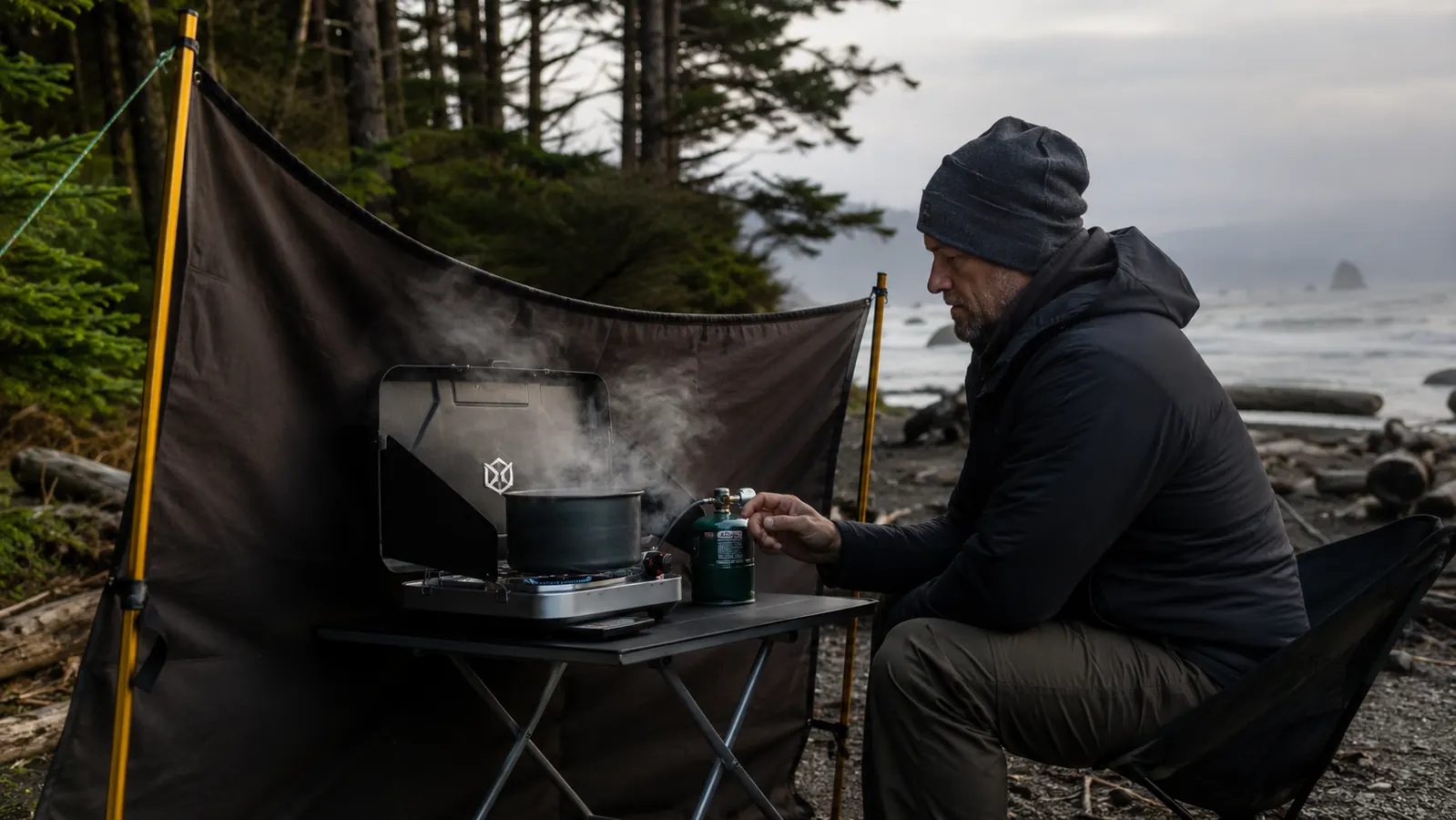
Every photo of the BottleTop shows a tidy squat ring around the burner and implies that the wind problem is solved. In a light breeze, sure, that ring does real work and the flame stays seated on the pot better than most boxless competitors. But the Pacific Northwest coast does not do light breezes. In a proper gust off the water, the wind does not care about your little ring, it blows straight sideways across the flame and it wobbles the whole assembly, because here is the first thing none of the reviews mention: the bottle, the stove head, and your whole pot are stacked on top of that one-pound canister, and the whole thing is top-heavy.
A tall pot of water for washing dishes, or a big stockpot you thought would be fine, turns the BottleTop into a small, anxious stack that leans in the wind and will absolutely tip if you are not holding it or have not wedged it against something. The fix is boring and I do it every time now: a rock or a chunk of firewood against the base of the canister, or a tarp rigged as a partial windbreak on the gust side. Once I accepted that the advertised wind resistance means less gust, not no gust, it stopped surprising me and just became part of the routine. But go in knowing the shield earns its keep, it does not let you forget the wind exists.
And here is the nuance I want to make sure lands. A gusty campsite is manageable once you know the rules, but a coastal evening can outsmart the setup entirely, and the honest user learns to read the wind before he cooks. I check which way the tree tops are bending and rig my windbreak upwind before I even light the burner, because chasing the wind after you are holding a hot pan is how you end up with bacon on gravel. Treat the wind as part of the recipe and the BottleTop will reward you; treat it as an afterthought and it will humble you. That is the whole story about this stove in one line.
The bottle, the stove head, and your whole pot are stacked on that one-pound canister, and the whole thing is top-heavy. Nobody mentions that part.
The Valve Has Range, Not Precision
The reviews that call the simmer range a genuine selling point are half right, and the half they miss is the frustrating one. The BottleTop can absolutely hold a gentle flame, I have kept a pot of rice low and slow without scorching it, when I dialed it in just so. But it is not a precise valve and it does not feel like one. The range between low and medium is small and crowded, and on a cold morning with thicker gloves you are essentially guessing, because a hair past the sweet spot dumps in noticeably more flame and a hair before it nearly goes out. That is the real simmer experience, fussy, not effortless, and nobody phrases the marketing to prepare you for the fuss.
This matters most for coffee and for anything you want to keep warm instead of just blast. I have a pot of coffee that needs to sit just under a boil, and on this stove that takes my full attention for the first five minutes until the valve is seated where I want it. It is doable, and it is worth doing because it beats a two-mode burner that only boils or goes out. But if you pictured set-it-and-forget-it simmering, lower the expectation. This is a stove that rewards patience and punishes multitasking. There is a technique to it, and like most technique, you only learn it by scorching a pot or two first.
Cold Canisters Make It Moody Late in the Bottle
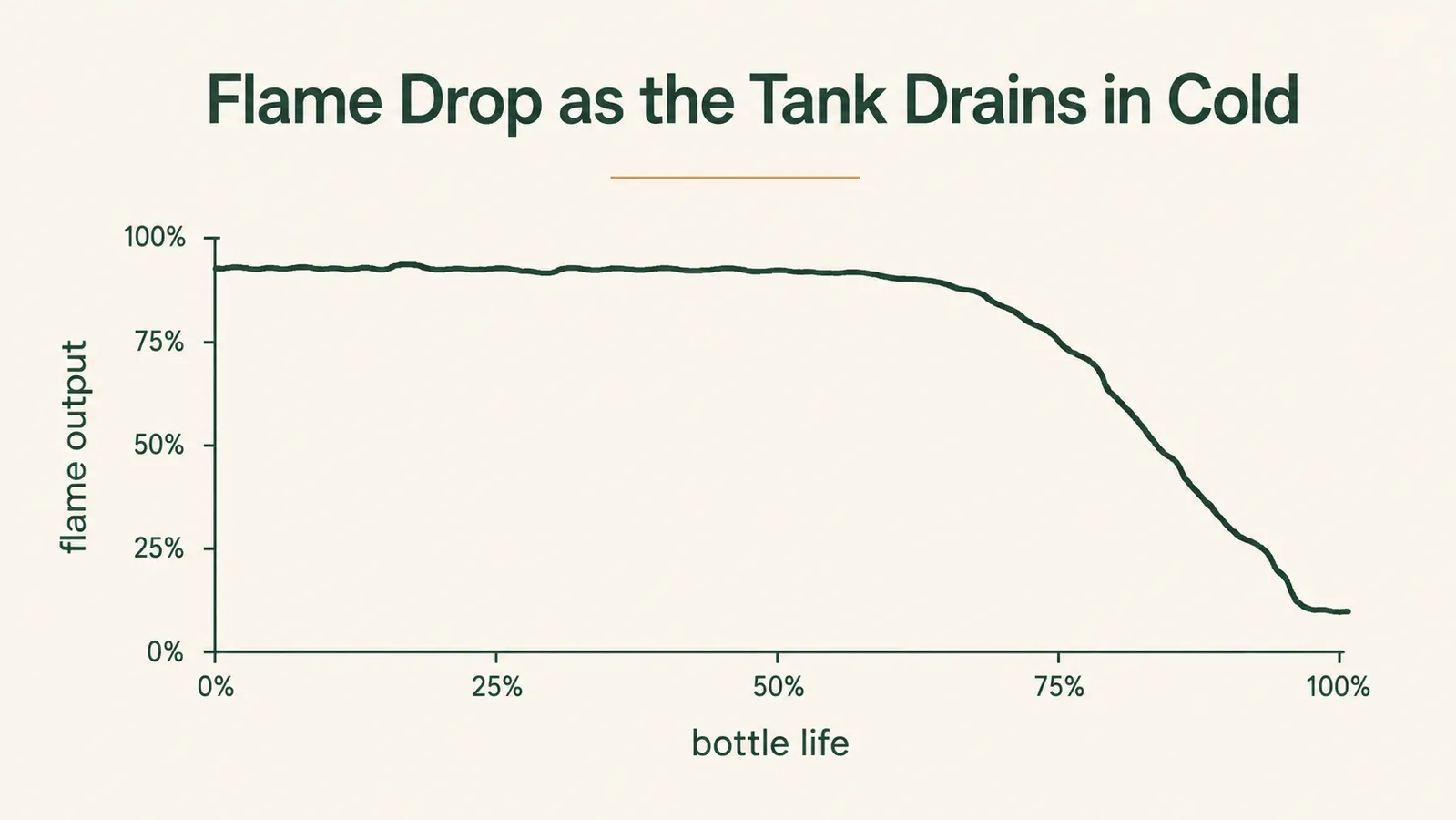
Here is the trade-off nobody on the box warns you about, and it is the one that surprised me most. The BottleTop burns straight off a one-pound propane canister, which is its whole appeal, cheap, simple, no hose, no butterfly regulator to fiddle. But the canister gets cold as it expels gas, and the colder it gets, the lazier the propane wants to flow. On a genuinely cold morning, with the bottle half empty and the thermometer down near freezing, the flame will start to fade partway through your cook, sputtering and weak exactly when you are trying to finish dinner. It is not that the stove has failed, it is the physics of a starved canister, but you will not know that until you are mid-rice and the burner gives up the ghost.
A fresh bottle in moderate weather burns like a champ, which is why the reviews all sound identical. The last third of a bottle, on a cold wet day, is where the BottleTop shows its honest personality. My workarounds are simple and you should steal them: warm the canister in my hands or against my leg for a minute before lighting, keep a fresh bottle on standby for the cold trips, and stop pushing a nearly empty one on a freezing morning. Once I understood the cause instead of blaming a broken stove, it stopped being a mystery and just became part of how I plan a cold dinner. But know that the moody teardown at the end of a bottle is real.
The Value Math, Honestly
The price question is where the BottleTop gets murky, because there are cheaper single-burners on the shelf and they will boil water too, right up until the day they do not. I have owned that cheaper stove, the no-name one that fired great in July and humiliated me at the first coastal gust. The reason the BottleTop still costs comfortably more is the metal, the regulator, and the parts that do not fail, and after watching cheap burners gutter out I will pay the difference every time. On pure boil-water duty a budget cooker is fine. On any real, repeated, all-weather cooking that expects to last more than a season, the BottleTop earns its extra dollars, and that is the fair way to state it.
But I will not pretend it is a steal for everyone. If you boil one pot of instant coffee per trip and never cook anything else, the cheaper stove is enough and you should save the money. If you need two burners for a family, a proper twin-stove is the answer, the BottleTop is single-burner only and no amount of clever rigging changes that. The honest position this review keeps landing on is narrow on purpose: as the dependable one-burner for a person who cooks real food outside in the Pacific Northwest, it is worth its price. As the cheapest possible way to make hot water, it is not, and you should not expect it to be.
There is also a kind of quiet math that only shows up after a year of ownership. Cheap stoves die in interesting places, in a rental car trunk or on a rain-bleak gravel bar, and they never die at a convenient time. The BottleTop has outlived two of my old budget burners and shows no sign of slowing, which is the part of the value story nobody can put on a spec sheet. If you buy gear the way I do, once and then for a long time, the extra you paid up front stops being an expense and starts being the price of not thinking about it, and that is a trade I will keep making. But I will say it plainly too: if hot water is the whole job and nothing more, spend less and do not look back.
Pros and Cons
What I Liked
- Fires up reliably and holds a steady flame through drizzle and moderate wind
- Real simmer range when you dial it in, good for rice, sauce, and coffee
- Solid metal build that survives being banged around the truck bed
- Cheap, simple one-pound canisters, no hose or regulator to fiddle
- Compact enough to live in the camp box without being a burden
Where It Falls Short
- Top-heavy in a gust with a tall pot, wants a rock or windbreak
- Valve is range-y but not precise, scorches a pot before you learn it
- Flame fades late in a cold, half-empty canister
- Single-burner only, no two-pot cooking for a crowd
- Not the cheapest way to just boil water, budget stoves win that fight
Who This Is For
The Coleman BottleTop is for the weekend camp cook who wants one burner that will actually be there when the weather turns, who cooks a real one-pot dinner instead of just boiling water, and who does not mind learning a small technique in exchange for dependability that lasts. If you camp in the Pacific Northwest through the wet seasons, if you run weekend trips and base camps rather than thousand-mile backpacking, and if you are tired of cheap stoves that smell like failure on their first gusty morning, this is an easy recommendation despite everything I just told you. It is the kind of stove you lend to a friend and only mildly worry about coming back in one piece.
One thing I have come to appreciate after a wet season is that the BottleTop rewards the person who treats camp cooking as a habit, not a one-off. The weekend regular who cooks the same way at home, who cares about a decent dinner after a day of hiking and fishing, who is willing to build a small routine around one dependable burner, that person gets the most out of this stove. It is not flashy and it will not audition for a gear magazine cover, but it will be the quiet piece of kit you reach for without thinking, the one that makes the whole camp feel a little more like home when the weather turns.
Who Should Skip It
Skip it if every gram counts and you are a solo backpacker, the BottleTop and its canister are heavy for that job and an ultralight is the right tool. Skip it if you need to cook for six people, one burner will not cut it and you want a proper twin-stove. And honestly skip it if you only ever make boiled water, because a cheaper single-burner does that one job for less money, no matter how nice the metal is. But if your picture of camp cooking is a real meal on a wet evening with a stove you can trust to still be working next season, the BottleTop's honest trade-offs are a fair price to pay, and knowing them ahead of time is the whole reason this review exists.
Now you know the ragged edges. Decide with both hands open.
The Coleman BottleTop annoyed me in three specific ways and I kept it anyway, because it is the one dependable burner in my truck. Check today's price on Amazon and see if its trade-offs are ones you can live with.
Amazon Check Today's Price on Amazon →